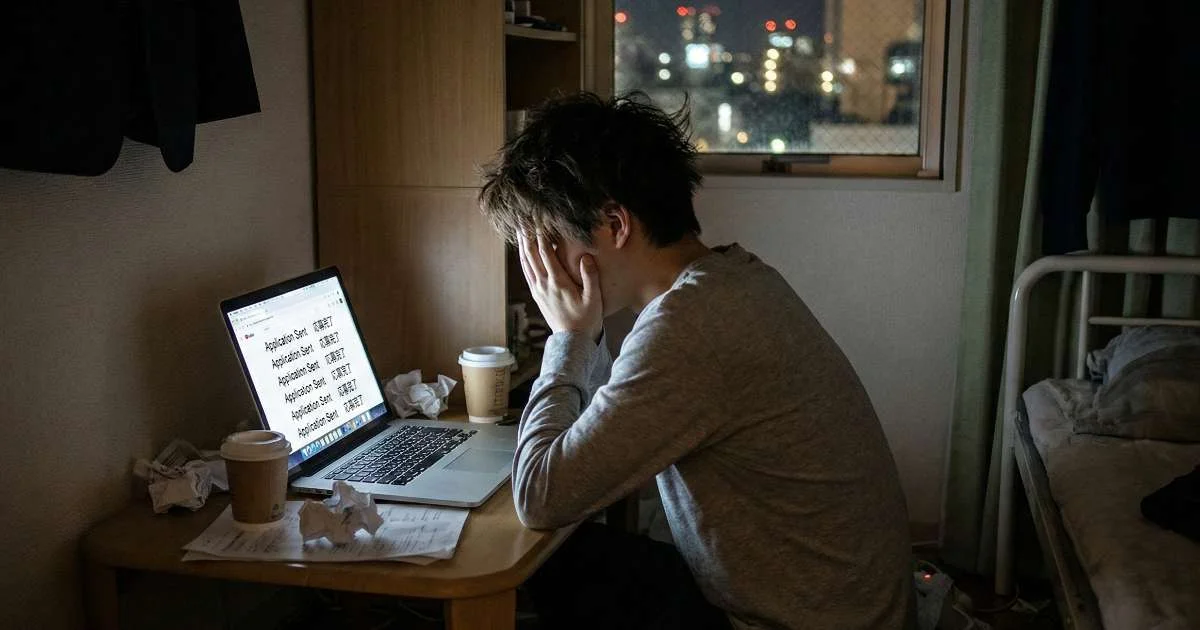

"Just apply more" sounds logical, but in Japan, it's one of the fastest ways to burn out, get stuck, and ruin future opportunities. Here is why.
If you're job hunting in Japan, you've probably heard this advice more than once: "Just apply more."
It sounds logical but feels productive. And in Japan, it's one of the fastest ways to burn out, get stuck, and ruin future opportunities. Here's why.
1. "Apply More" Leads to Burnout — Not Better Results
Job searching is emotionally expensive, especially if you're not used to constant rejection. In Japan, response rates for online applications are notoriously low. Many candidates never receive feedback at all.
Studies and recruiting reports consistently show that only a small percentage of online applications result in interviews, often well below 10% in competitive markets. What happens when you keep applying without results?
- Confidence level drops to the bottom.
- Motivation to build a career in Japan disappears.
- You start doubting your value as a candidate.
Burnout doesn't come from laziness — it comes from repeating effort without progress. And once you're exhausted, your self-presentation gets worse.
2. Doing the Same Thing That Doesn't Work Guarantees More Rejections
Most foreigners apply the same way: Same CV, same job boards, same "English OK" filters. If this approach didn't work for the first 20 applications, applying 50 more times won't magically change the outcome.
In Japan's hiring market, volume does not compensate for poor positioning. Recruiters scan CVs quickly, often in minutes. If your profile doesn't immediately match what they're looking for — language level, visa status, keywords— you're filtered out automatically.
3. Applying to the Wrong Jobs Can Hurt You Later
This is something most job seekers don't realize. When you apply to a role you're clearly not qualified for, your profile often gets stored in the company's or recruiter's database — marked as "rejected."
Later, even if you improve your skills or reach out directly, there may already be a negative trace attached to your name: *"This candidate was already screened and rejected."*
In Japan, where hiring is risk-averse and reputation-sensitive, first impressions matter more than people admit. Applying randomly can quietly close doors you didn't even know existed.
4. You're Wasting Time Competing for the Most Crowded Jobs
Public job boards represent only around 20–30% of total hiring (a global recruiting benchmark). Yet most foreigners spend nearly 100% of their effort competing for those roles.
For example, if 100 people apply to a single job posting, your chances of success drop to around 1% — and that's before language, visa, or cultural fit are considered.
That same time could be used to:
- Research companies not actively posting jobs
- Identify businesses with foreign-oriented markets
- Build direct connections or warm introductions
- Access the hidden job market, where competition is lower and hiring is faster
In some markets, mass applications can still work. Japan is not one of them. That's why many professional roles are filled before they're ever publicly posted.
What to Do Instead
Getting a job in Japan isn't about how many applications you send. If you want real progress in Japan, shift from volume to strategy:
- Apply less, but more intentionally to the roles you are qualified for
- Stop limiting yourself to English-only roles and look more broadly at the market.
- Improve self-presentation (CV, portfolio, cover letter)
- Focus on companies and roles outside job boards
- Spend time accessing the hidden job market
Once you change that, the rejections slow down — and interviews start happening.